
What does an electro-hydraulic operating table actually give you? Support that holds. Positioning that changes on command. Clearance for the C-arm when imaging shows up mid-case. Every one of those affects the people working around the patient, surgeon on down to scrub nurse. A badly set table slows the whole room. Anyone who has done a shift in a busy OR already knows.
Manual tables make staff do the cranking. By hand, every single time. Electro-hydraulic models split the job differently. Electronics decide. Hydraulics push. The heavy lifting lands on the machine instead of somebody’s back, even with a big patient on the tabletop.
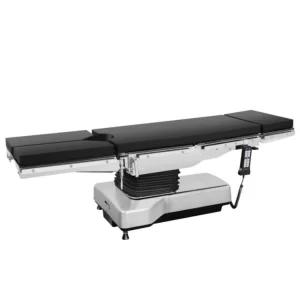
The AMT-D.III-II electro-hydraulic operating table is a solid example. Adjustable tabletop. Controls in two places. A layout that leaves the C-arm room to work. ORs that see a bit of everything should put it on the shortlist. It comes from ARI Medical.
How These Tables Actually Work
The System, in Plain Terms
Short version? Hydraulics move. Electricity controls.
Press a control. The hydraulic side answers. Whichever section you asked for moves. Which sections respond depends on the model. Height, both tilts, and longitudinal travel make up the usual set.
Hydraulics don’t run everything, mind you. Headrest, leg plates, most accessories. Those usually ride on gas springs or plain manual joints. Fine by us. Hand adjustment is often quicker for small tweaks anyway.
So the benefit is what, exactly? A patient surface that moves in a controlled, repeatable way. Range, speed, precision. Those vary table to table. Read the spec sheet. Don’t assume.
Controls and Stability
Reachable controls mean positioning gets fixed without stopping the case.
The AMT-D.III-II offers a handheld remote and a panel on the table. Both work. There’s also a self-locking feature and a one-key reset back to standard position.
Two control points sound like overkill. Then you need the second one mid-case, and it isn’t. Self-locking matters too. A bumped button should never move a patient.
Before the patient goes on, check the table. Movements. Locks. Accessories fitted. Two minutes at most. That habit prevents the ugly surprises.
Stability is bigger than the table, though. Supports count. Technique counts. What the monitors tell the anesthesia team counts.
Positioning Functions and Their Surgical Uses
Height and Tilt
Ask a surgeon who spent hours bent over a badly set table. Working height matters. A lot. Powered adjustment sets it right at the start and nudges it later if the case turns.
Two situations come up over and over. Awkward working positions. Equipment crowding in next to the surgical field. Height adjustment helps with both.
Next, tilt. Trendelenburg and reverse Trendelenburg tip the tabletop along its length.
Trendelenburg. Head below feet. Certain pelvic and laparoscopic cases want it. Whether it suits your patient, that’s the anesthesia team’s call.
Reverse goes the other way. Head raised. Helps access in some upper-abdominal work.
Lateral tilt moves the tabletop side to side. Terminology warning, though. Tilting the table is not lateral patient positioning. That needs stabilizers and accessories, or the patient drifts.
How far, which way? Surgical and anesthesia teams decide. Nobody else.
Head, Back, and Leg Sections
Patients vary. Positions demanded by surgery vary more. Sectional adjustment is how one table copes with all of it.
Head section tilts for the neck. Back section angles the torso. Legs move on their own. That last one matters plenty in lower-limb cases.
AMT-D.III-II detail: gas springs assist the head and leg plates. No brute force needed. Leg plates split and detach too, useful when a configuration wants the lower field open.
All told, a wide spread of positions. Right for a given case? Depends on the procedure, the patient, the accessories on hand.
The Positions You’ll Actually Use
Each procedure has a favorite position.
| Surgical Position | Typical Applications and Considerations |
| Supine | Used in many general surgical procedures; requires suitable support and pressure protection |
| Trendelenburg | May be used in selected pelvic and laparoscopic procedures; positioning angle requires clinical assessment |
| Reverse Trendelenburg | May support selected upper-abdominal procedures; anesthesia and patient stability must be monitored |
| Lateral Decubitus | Used in certain thoracic and urological procedures; requires dedicated positioning supports |
Treat the table below as general practice. Before any configuration gets locked in, confirm three things. Intended use. Adjustment range. Accessories that actually fit.
C-Arm Compatibility and OR Workflow
Imaging and Tabletop Movement
Imaging mid-surgery comes down to clearance.
A C-arm circles the patient, hunting for angles. So tabletop design, base shape, longitudinal travel. Suddenly they’re dealbreakers, not details.
ARI Medical thought about this on the AMT-D.III-II. Carbon-plastic tabletop, nearly invisible to the beam. Sliding function to line the patient up with the imager.
Sliding deserves a second look. Patient shifts. Table stays put. Simple as that.
Compatibility claims still deserve suspicion. Your imager. The radiolucent window. Dimensions. Clearance. Every item has to agree.
Smart hospitals rehearse the setup first. Some pairings disappoint. Marketing glosses over that.
Everything Shares One Room
Tables don’t work alone.
Around it: anesthesia machine, lights, monitors, imaging cart. One patient, few square meters, lots of equipment.
Now the table moves mid-case. Cables. Tubing. Supports. The sterile boundary. Something snags. Often does, when nobody planned.
Hence the appeal of operating theatre solutions like ARI Medical’s. Tables and the surrounding equipment, designed together for one room.
Plan the layout early, every device included. Conflicts surface on paper. Not on surgery day.
AMT-D.III-II Features and Specifications
Technical Highlights
So what’s inside? Electro-hydraulic drive. Sections that adjust independently. A tabletop arranged for imaging work.
Numbers below.
| Feature | AMT-D.III-II Specification |
| Operating System | Electro-hydraulic |
| Tabletop Length | 2,000 ± 100 mm |
| Tabletop Width | 520 ± 20 mm |
| Height Adjustment | (650–1,100) ± 50 mm |
| Lateral Tilt | Left ≥20°; Right ≥20° |
| Trendelenburg | ≥30° |
| Reverse Trendelenburg | ≥30° |
| Tabletop Movement | Longitudinal movement; specified horizontal and longitudinal movement of 400 ± 30 mm |
| Control System | Handheld remote and control panel |
| Head and Leg Plates | Gas-spring-assisted adjustment |
| Leg Plates | Split and detachable |
| Main Frame Components | 304 stainless steel |
| Mattress | High-density memory foam with artificial-leather covering |
| Additional Functions | One-key reset and electric braking |
Spec tables have limits. They say what the machine does. Fit for your patients, procedures, room? Different question. Read the operating manual before deciding.
Procuring? Get the supplier to confirm current specs and accessory stock. Paper ages.
Materials and Daily Handling
Materials decide daily life with the table. Cleaning. Wear. Inspection. Everything.
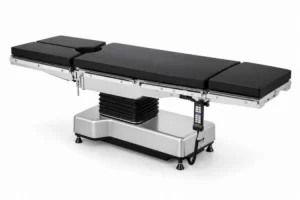
304 stainless steel on the AMT-D.III-II’s key structure. Support frame under the tabletop. Side rails. Accessories.
Mattress up top. High-density memory foam inside. Seamless artificial leather over it.
Seamless. That’s the operative word. Fluids have nowhere to creep. Wiping stays quick. Keep cleaning agents inside what the manufacturer allows.
Braking is electric. Moving the table itself becomes a one-person job.
Not the right mix? The wider operating table range from ARI Medical carries other movement systems and layouts. Compare before settling.
Electro-Hydraulic or Electric?
Two Ways to Move a Table
Both types power their positioning. Underneath, different story. One pushes fluid. The other spins motors and mechanical parts.
| Comparison | Electro-Hydraulic Operating Table | Electric Operating Table |
| Drive Mechanism | Hydraulic actuation under electrical control | Electric motors and mechanical actuators |
| Movement Control | Electrical control of hydraulic mechanisms | Electrical control of motor-driven mechanisms |
| Maintenance Focus | Hydraulic components, seals, and electrical controls | Motors, actuators, transmission components, and electrical controls |
| Positioning Performance | Depends on the specific model | Depends on the specific model |
| Surgical Applications | Suitable for various procedures according to configuration | Suitable for various procedures according to configuration |
Which is more precise? More durable? People argue. Without verified specs, the argument is noise.
ARI Medical’s AMT-D.IA electro-hydraulic operating table shows the pattern. Dual controls. Imaging-friendly tabletop. Same family as the AMT-D.III-II. Height range? Different numbers. Check.
Choose by application. Not by actuation method.
What Buyers Should Check
Hospital buyer, distributor, project planner. Doesn’t matter. Specs mean nothing until measured against real clinical requirements.
Start here:
Safe working load. Weight limits. Loading conditions. No guessing.
Positioning range. Height, tilts, sections, sliding distance.
Imaging compatibility. Radiolucent area, C-arm clearance, dimensions versus your gear.
Power. Specs, plus backup for an outage.
Accessories. Standard in the box, or extra cost.
Service. Cleaning, spares, documentation, who answers after the invoice.
Imaging-heavy departments should dig deeper. Dimensional drawings first. Then a sit-down with clinical and biomedical engineering. They’ll catch your clash.
Keeping It Running
Inspections. Boring, essential. Odd noises, visible damage, sticky controls. Small finding now, no failed case later.
Manufacturer’s checklist. Mattress cover. Rails. Supports. Controls. Moving sections. Brakes.
Disinfectants need watching. Harsh chemistry chews up mismatched coverings.
Scheduled servicing covers the rest. Hydraulic, electrical, mechanical. Qualified people only.
Behind its tables, ARI Medical provides after-sales services and technical support. Before buying: warranty terms, spares arrangements, maintenance duties. Get them written down for your model.
Who Is ARI Medical?
ARI Medical has supplied medical equipment for over twenty years. Hospitals. Surgical departments. Facilities big and small.
Tables. Anesthesia machines. Lamps. Monitors. The surgical suite essentials, one portfolio.
New build, upgrade, or distribution. They’ll talk configurations for any of it.
Specs, accessories, quotes matched to use. All on request.
Need One for Your Project?
Request a Quote from ARI Medical comes next. Bring specs and constraints. The conversation handles itself.
Conclusion
Where does that leave us? Powered control. Adjustable sections. Coexistence with the rest of the OR. That’s the electro-hydraulic case.
Height, tilt, sliding, sections. Each answers a need that shows up in real procedures.
The AMT-D.III-II bundles it, C-arm support included. Credibly.
One question for hospitals and distributors. Verified specs, positioning range, support package. Do they fit the destination environment? Answer that. The rest follows.
FAQ
Q1: What Is an Electro-Hydraulic Operating Table?
Electrics control. Hydraulics move. Model decides which functions ship. Height, tilt, longitudinal travel, usually.
Q2: What Surgical Positions Can an Electro-Hydraulic Operating Table Support?
Supine, both Trendelenburgs, often more. Accessories permitting. Suitability per patient and procedure? Clinical judgment, always.
Q3: Can an Electro-Hydraulic Operating Table Be Used With a C-Arm?
Some can. A few are built around it. AMT-D.III-II pairs carbon-plastic tabletop with longitudinal sliding for that reason. Verify against your C-arm before case one.
Q4: What Is the Difference Between Electro-Hydraulic and Electric Operating Tables?
Actuation. Hydraulics under electric control versus motors on mechanical parts. The rest follows each maker’s design choices.
Q5: What Should Hospitals Check Before Purchasing an Operating Table?
Load limits. Dimensions. Ranges. Imaging compatibility. Accessories. Electrics. Maintenance. Supplier support. Eight boxes. Tick all.
Q6: How Should an Electro-Hydraulic Operating Table Be Maintained?
Manufacturer’s schedule, followed properly. Inspections hit hydraulics, electrics, controls, sections, brakes, accessories. Regular cycle.