
Four jobs run at once inside an anesthesia machine. It mixes medical gases. A dial sets the anesthetic vapor strength on top of that mix. Surgery demands stillness? Then the machine breathes for the patient. Pressure gets watched. Volume too. Oxygen concentration with them, breath after breath.
That is the short answer to how one works. The details are where machines separate, though. How steady is the vaporizer output? What happens the moment a gas supply drops? Will the same platform run a neonate on Tuesday and a heavy adult on Thursday? Purchasing teams live on those questions. Below, the path gets taken apart piece by piece, ending with the checks to finish before an order goes out.
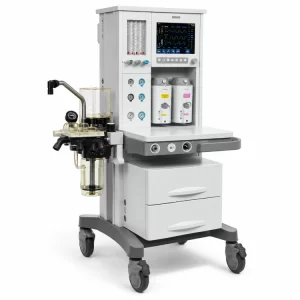
How the Gas Moves: an Anesthesia Machine’s Working Principle
The gas follows one path. Oxygen, nitrous oxide, and medical air come in from the hospital pipeline at supply pressure. Regulators step that down. Each gas gets metered. Vaporizer next. Its job is adding anesthetic vapor to the carrier gas, at the strength the anesthetist dials in. The breathing circuit does the last leg, carrying that mix down to the patient.
Now the return trip. Soda lime waits on the way back. It grabs carbon dioxide straight out of the exhaled gas. What is left rejoins the fresh gas. Next breath. Round it goes. The loop is why fresh gas flow can sit low. It saves agent and holds humidity inside the circuit.
The older textbooks oversell a point here. Most patients under general anesthesia breathe less than they should, and their airway reflexes dull. Usually, never always. Does the ventilator take over? Anesthetic technique decides it. So do the drugs on board and the patient lying there. Once it takes over, every breath rides either a set volume or a set pressure. The capnograph then tells you what truly reached the lungs.
Anesthesia Machine Components, One by One
Brands package these parts differently. The anesthesia machine range on the market stretches from plain continuous-flow units to fully electronic workstations. Under the casing, though, the logic barely changes.
Gas Supply and Flow Control
Start at the wall. Pipeline gas feeds daily work. Backup cylinders sit on the yoke for the day a supply line fails. Regulators hold working pressure steady while sensors watch it. Then the flowmeter bank, where the mixture actually gets decided. Glass rotameters on older machines. Electronic proportional valves and a screen on newer ones. Same job either way.
Anesthetic Vaporizer
Liquid agent goes in, usually isoflurane or sevoflurane. What comes out is vapor at a set percentage, somewhere in the 0 to 6 vol% band. No vaporizer on the market is perfectly precise. Manufacturers worth trusting publish their accuracy limits. Quiet ones skip that step. Room temperature shifts. Back pressure drifts. Flow rate wanders. A good vaporizer compensates for all of it on its own, and the dialed concentration stays inside the stated accuracy limits even five hours into a case. Fill the machine with the wrong agent? Agent-specific keying stops that. Cheap insurance.
Breathing Circuit, CO2 Absorber, and Ventilator
The circle circuit moves gas to the patient and back. Direction is handled by one-way valves. Over in the canister, soda lime strips the CO2 out. Comparing machines? Look hard at the canister design. The AR-D3 anesthesia machine solves this with a by-pass design. The canister gets isolated. Swapped mid-surgery. Ventilation never breaks. There is a heater built into the integrated circuit too. Condensation stays down because of it. Readings stay honest as well.
The ventilator handles volume control and pressure control, with spontaneous modes for lighter planes of anesthesia. Monitors sit around it. Airway pressure shows up beside tidal volume on the screen, with end-tidal CO2, inspired oxygen, and agent level alongside. Numbers refresh every few seconds. Drift on any of them? Trouble announces itself there first, long before anything worse.
Anesthesia Machine Compared With an ICU Ventilator
The two get mixed up all the time. To be fair, every generation overlaps more. The line still holds, though.
| Comparison angle | Anesthesia machine | ICU ventilator |
| Main job | Delivers anesthetic agent during the surgery | Long-term respiratory support, ward work |
| Agent delivery | Built-in vaporizer for volatile agents | Not available |
| CO2 handling | Soda lime absorption inside a closed circuit | No absorbent, open circuit with external humidification |
| Typical stay | Hours, one surgical case at a time | Days to weeks on one patient |
| Mobility | Wheeled between theatres daily | Stays at the bedside |
No ward ventilator delivers sevoflurane. No theatre machine holds a patient for two weeks. Running both environments means buying both, with the budget lines kept apart.
The Safety Features Inside Modern Anesthesia Machines
Oxygen supply failure is the classic scenario. Machines answer it in layers. Supply-pressure monitoring is the first to spot the drop. Oxygen and nitrous oxide travel through a proportioning link, usually a mechanical one. Its whole purpose is squeezing the mix down before an oxygen-poor blend ever reaches the patient. Downstream of that, the inspired-oxygen analyzer reports what the lungs truly receive instead of what someone set. Alarms back everything up. One device alone cannot remove every hypoxic-mixture risk, which is exactly why the standards stack several of them.
Then the rest. Disconnect alarms. High-pressure alerts. Low volume gets flagged too. Waste anesthetic gas leaves through its own scavenging duct, straight out of the theatre. Brochure photos never show any of this. Trace agent stays out of the air, and the first time a circuit lets go you will be glad the alarms were there.
Anesthesia Machine Buying Guide for Theatres and Clinics
Buyers who get this right work the list in order. Patients first. Then modes, monitoring, gas supply. Consumables and service last, even though those two quietly decide your running costs.
| Checkpoint | What to confirm with the supplier |
| Patient range | Neonatal and pediatric and adult coverage matched to your actual case mix |
| Ventilation modes | Volume control and pressure control at minimum, plus spontaneous support if your technique needs it |
| Monitoring | End-tidal carbon dioxide, agent level, inspired oxygen, airway pressure |
| Gas supply | Pipeline and cylinder support, battery backup where power supply is unstable |
| Consumables | Canister design, circuit material, the yearly soda lime and circuit bill |
| Service and certification | Local technical support, spare parts stock, certification for your target market |
Space changes the answer. A dental suite. A remote clinic. A disaster station. Those doors will not take a full workstation. A dedicated portable anesthesia machine will, and that is exactly its job.
Service life belongs in the same conversation. Every morning takes five minutes. A leak test plus an alarm check, wrapped up before anyone rolls in. For everything past the daily routine, the manufacturer-recommended inspection and calibration schedule beats what any improvised habit will manage. And keep that service log complete. Machines with a documented history hold their accuracy. They hold resale value too.
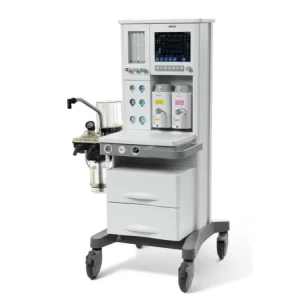
ARI Medical Anesthesia Machines
ARI Medical has built operating theatre and hospital equipment for over twenty years now. Anhui, Jiangsu, Guangdong. Three manufacturing bases in total. ISO 9001 and ISO 13485 are the quality systems those factories answer to. Equipment leaves with CE and FDA accreditation. More than 100 countries take the exports, hospitals included. Installation guidance and operator training come in the package as well.
Mid-line sits the AR-D3. The interface lives on a 10.4-inch color touch screen. Tidal volume spans 5 to 1500 ml. One platform, neonate to adult, no machine swap between cases. Three gases, metered by up to five flow tubes. The by-pass soda lime canister mentioned earlier swaps out during a case. The same line steps down for smaller theatres and clinics, core safety architecture intact.
Installation, operator training, after-sales support. The supplier’s service team owns all of it. Want a quotation or a demo? The contact page is where both start.
FAQ
Q1: How many years will an anesthesia machine last?
A1: Ask five engineers and you will hear five numbers. Usage intensity matters. How faithfully the hospital follows its maintenance schedule counts as well. Parts stock at the manufacturer decides plenty too. Serviced on schedule with a complete log, plenty of units still work clinically past the ten-year mark. Nearly every time, the sensors and electronic modules give out before the frame.
Q2: When should the CO2 absorbent be changed?
A2: Universal timetables lose to the manufacturer’s instructions. Color change in the granules is a hint. Only a hint, because absorbent can exhaust unevenly inside the canister. Capnography is the practical check in the room. Rising inspired CO2 on the monitor flags the problem before the case is affected.
Q3: What makes an anesthesia machine different from an ICU ventilator?
A3: Days or weeks on one patient, zero anesthetic agent. That is an ICU ventilator for you. Ventilation comes standard, then the anesthesia machine layers in a vaporizer, carbon dioxide absorption, and waste-gas scavenging, all sized for hour-long cases.
Q4: Will one machine handle human and veterinary cases alike?
A4: The physics match. Certification and circuit sizing do not. Occasional animal cases? A human-rated unit manages. Clinic work day after day belongs to a dedicated veterinary anesthesia machine, built and priced for it. A few years out, the dedicated unit wins on economics.
Q5: What does a hospital need ready before requesting a quotation?
A5: Three things move it fastest. Your case mix, with the patient range. Your gas supply conditions, pipeline availability and cylinder backup included. And the vaporizers and monitoring you expect. Include those and the returned quote fits the theatre rather than a generic catalog page.