
Choosing a tabletop autoclave starts with a simple question: what does your department need to sterilize every day? You should then check the daily workload, usable chamber space, operating steps, safety controls, cycle records, and supplier support. Price matters, but it should not be the first filter. A low-priced unit can become expensive when it is too small, hard to clean, difficult to document, or poorly matched to your instruments.
You also need to look beyond the word “capacity.” Two units with similar chamber volumes may handle instruments very differently. Tray layout, chamber depth, cooling, water quality control, and data storage all affect daily work.
The following seven factors will help you choose a tabletop autoclave that suits real hospital work rather than one that only looks good on a quotation.
1. Match the Autoclave to Your Instrument Types
Start with the instruments, not the machine. Make a list of what your department processes during a normal week. Include the materials, sizes, packaging methods, and any special handling rules.
A hospital dental department may have a very different load from a minor surgery room. Glassware, dental tools, surgical instruments, and injection-related items do not always use the same arrangement. Some objects may not tolerate steam, heat, or pressure at all.
Check Material and Steam Resistance
Confirm that every item is suitable for steam sterilization. Review the instrument manufacturer’s instructions before setting a cycle. Do not assume that every reusable medical item can enter an autoclave.
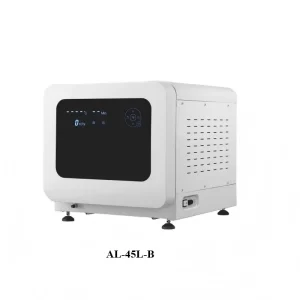
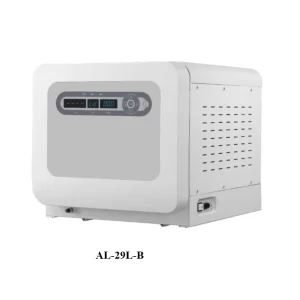
The AL-29L/45L-B (LED) Table Type Pulse Vacuum Steam Sterilizer (Touch Screen) is designed for several common hospital loads. These include surgical instruments, dental instruments, glassware, injection units, and other objects that resist pressure and hot steam.
That makes it a practical option for departments with mixed routine loads. Even so, you should still confirm the correct cycle for each instrument group.
Review Your Actual Load Mix
Do not choose a unit based on one occasional instrument set. Look at the items processed most often. If your department handles many long instruments, deep trays, or several small sets at once, chamber shape may matter more than the stated volume.
A clear load list also helps the supplier recommend the right configuration. It reduces vague quotations and saves time during technical discussions.
2. Calculate the Daily Sterilization Capacity You Need
A small chamber may have a lower purchase price, but it can force your staff to run too many cycles. That creates waiting time during busy periods. An oversized unit may use more counter space and power than your department needs.
The right capacity should cover normal demand, peak demand, and reasonable future growth.
Count Loads Rather Than Individual Instruments
Instead of counting individual instruments, estimate how many complete loads your department processes each day, especially during peak hours, and whether one sterilizer will serve multiple rooms.
The AL-29L-B provides a 29L chamber, while the AL-45L-B provides 45L. The smaller version may suit a department with steady but moderate work. The larger version gives more depth for departments that need to process more items in one batch.
Leave Enough Working Capacity
Do not fill the chamber simply because space remains. Steam needs room to move around the load. Crowded trays may affect air removal, steam contact, drying, and handling after the cycle.
Choose enough capacity for correct loading, not maximum physical packing. A little spare room also helps during busy days or future growth.
Power requirements matter too. The 29L model is rated at 2500W, while the 45L model is rated at 3300W. Check your local power supply before ordering.
3. Check the Chamber and Tray Layout
Liters are useful for comparison, but they do not show whether your instruments will fit. Chamber diameter, depth, tray count, and access all affect usable space.
Before buying, measure the longest instrument set and the largest container you expect to load. Compare those measurements with the chamber, not only the outer machine size.
Compare Chamber Depth
Both versions have a chamber diameter of 319mm. The 29L chamber is 420mm deep, while the 45L chamber is 620mm deep.
That extra depth may help when you process longer instrument sets or want to reduce the number of separate loads. It also makes the machine itself deeper. The 29L model measures 535 × 650 × 505mm, while the 45L model measures 535 × 850 × 505mm.
Measure the counter, door clearance, ventilation space, and maintenance access before selecting the larger unit.
Look at Tray Access
The tray rack in this model can rotate 90 degrees and hold five trays. This gives staff more choice when arranging instruments and makes better use of the chamber.
Still, tray count should not be treated as a promise that every tray can always be fully loaded. The final arrangement depends on instrument size, wrapping, spacing, and the selected cycle.
Ask for tray dimensions and loading guidance before placing a bulk order.
4. Make Sure Staff Can Use It Without Extra Steps
An autoclave may run several times a day and may be used by different shifts. A complicated interface becomes a daily problem. Staff need to select cycles, check status, respond to warnings, manage water, unload instruments, and save records without wasting time.
Simple operation does not mean fewer controls. It means that the controls are clear.
Check the Control Interface
The AL-29L/45L-B uses a touch screen. During product review, ask what information appears on the screen, which cycle parameters are visible, and how the unit reports warnings or cycle completion.
Also confirm the available interface language. A clear screen is useful only when local staff can read and operate it correctly.
Training should cover more than pressing the start button. Staff need guidance on loading, water use, routine cleaning, cycle selection, record handling, and basic fault checks.
Review the Full Daily Routine
Watch how the whole process would work in your department. Can staff open the water tank easily? Are the trays comfortable to remove? Can they clean the unit without moving other equipment? Can they reach the USB port?
These small points affect daily use. A unit that saves a few minutes during each load can make a real difference over hundreds of cycles.
5. Inspect the Safety and Water-Control Design
A tabletop autoclave works with heat, pressure, steam, and repeated mechanical movement. Safety features should not sit at the bottom of the specification sheet. They should be checked early.
The chamber, door, pressure release, air filtration, and water system all need attention.
Hospital buyers should also verify that the selected model complies with the applicable version of EN 13060 and all local regulatory requirements before purchase. Request model-specific certificates and test documents rather than assuming compliance from the supplier’s general quality certifications.
Check Door and Pressure Protection
The touch-screen tabletop autoclave uses a double-lock system that combines a mechanical lock with an air-lock system. It also has a safety valve that releases excess pressure and helps restore idle chamber pressure when overpressure occurs.
Its six-layer chamber structure is made for pressure resistance and has passed 60,000 fatigue-life tests. Two condensers support faster cooling and help reduce stress on the system during repeated use.
These details are more useful than an attractive outer shell. They relate directly to long-term hospital operation.
Pay Attention to Air and Water Quality
An air filter helps prevent airborne impurities from entering the chamber. Ask how often the filter needs replacement and whether spare filters are easy to order.
The open water tank is designed for easier cleaning. A built-in water quality sensor monitors the water and helps reduce avoidable machine faults. This feature is helpful, but it does not replace correct water preparation or scheduled cleaning.
Your team should follow the specified water requirements. Poor water quality may lead to deposits, stains, blocked parts, and more maintenance work.
6. Decide How You Will Record Every Cycle
Hospitals often need to review sterilization records during internal checks, maintenance work, or incident investigations. Handwritten records may still form part of the process, but relying on them alone creates gaps.
Before purchasing, ask exactly what the autoclave records and how you can retrieve the data.
Check Digital Record Storage
The unit has a USB master controller that stores the latest 2,000 cycles. Staff can download the information through USB, then review or print it on a computer.
This helps you keep a clearer cycle history. It also makes it easier to check past operation when a problem appears.
Digital cycle records also improve traceability during audits, accreditation inspections, infection-control reviews, and investigations of sterilization failures.
Do not stop at the question, “Does it have USB?” Ask which cycle details are saved, what file format is used, and how records are matched with instrument loads.
Choose the Right Printing Option
A micro-printer is available as an option. It can print cycle data when the cycle ends.
Some hospitals prefer paper records for every batch. Others store records digitally. Some use both. Choose the option that matches your internal process and local documentation rules.
You should also confirm printer paper availability and replacement costs before ordering.
7. Evaluate Service Before You Compare the Final Price
A tabletop autoclave is not a one-time purchase. You may need installation advice, operator training, technical documents, troubleshooting, replacement parts, and maintenance support throughout its working life.
A cheaper machine with weak support may cause longer downtime and higher costs later.
Ask Practical Service Questions
Before placing the order, ask who will help with installation, commissioning, staff training, fault checks, and spare parts. Confirm the warranty scope and the expected response time for technical questions.
ARI has more than two decades of experience in medical equipment and hospital projects. It operates three production bases under ISO 9001 and ISO 13485 quality systems and supplies equipment to healthcare facilities in more than 100 countries. For autoclave projects, its support can include product selection, installation guidance, staff training, maintenance, spare parts, and after-sales communication.
Prepare the Information Suppliers Need
The AL-29L/45L-B is worth shortlisting when you need a tabletop pulse vacuum steam sterilizer with two capacity choices, five-tray loading, a touch screen, water quality monitoring, safety controls, air filtration, USB records, and an optional printer.
It may not be the right model for every hospital. The right choice depends on your load, cycle requirements, room space, power supply, daily volume, and local rules.
Before requesting a quotation, prepare the following information:
- Hospital department and intended use
- Instrument types and packaging methods
- Average and peak daily load volume
- Preferred chamber capacity
- Local voltage and frequency
- Available installation space
- Required certificates and technical documents
- Order quantity, training, and service requirements
Providing complete information allows the supplier to recommend a more suitable configuration and prepare a more accurate quotation.
FAQ
Q1: What Size Tabletop Autoclave Does a Hospital Need?
A1: The right size depends on daily load volume, instrument dimensions, peak workload, available counter space, and future demand. The 29L version suits moderate loads, while the 45L version offers more chamber depth and batch capacity.
Q2: What Instruments Can the AL-29L/45L-B Sterilize?
A2: The AL-29L/45L-B is suitable for surgical instruments, dental instruments, glassware, injection units, and other objects that resist pressure and hot steam. You should still follow each instrument manufacturer’s sterilization instructions.
Q3: Why Does Chamber Size Matter More Than Capacity Alone?
A3: Capacity only shows total volume. Chamber diameter, depth, tray layout, instrument length, wrapping, and required spacing determine how much equipment you can load correctly.
Q4: Does the AL-29L/45L-B Store Sterilization Records?
A4: Yes, its USB master controller stores the latest 2,000 cycles. The data can be downloaded, checked, and printed on a computer. An optional micro-printer can also print cycle data.
Q5: What Information Should You Send Before Requesting a Quote?
A5: You should provide your hospital department, instrument types, estimated daily loads, preferred capacity, local voltage, installation space, order quantity, required documents, and service or training needs.
Q6: How Often Should a Tabletop Autoclave Be Maintained?
A6: Routine cleaning, inspection, and preventive maintenance should follow the manufacturer’s instructions and hospital protocols. Preventive maintenance should be performed by qualified personnel at the intervals specified by the manufacturer.