
A Coagulation Analyzer should match the tests you run, the number of samples you handle, and the level of quality control your laboratory needs. Price matters, but it should come after test coverage, channel capacity, temperature stability, repeatability, reagent use, data handling, and after-sales support. A low-cost unit can become expensive if samples wait too long, results need repeated checks, or the system cannot support your daily test menu.
ARI is a medical equipment manufacturer specializing in hospital and laboratory solutions, with more than 20 years of industry experience. Its production facilities operate under ISO 9001 and ISO 13485 systems, and its equipment has been supplied to healthcare facilities in more than 100 countries.
Why Is Price Alone Not Enough?
The first quotation is only the starting point. Your real cost includes sample handling, operator time, reagents, result storage, printer supplies, calibration, quality control, maintenance, and delays during busy periods.
Match Channel Capacity to Daily Workload
Start with your normal day, then check your busiest hour. A single-channel system may be suitable for low-volume routine testing. Two channels can help when samples arrive together, while four channels may be more appropriate when the laboratory needs parallel testing or several parameters without a long queue.
Do not buy extra capacity only because the larger model looks better. Do not choose too little capacity just to lower the first invoice. The right channel count should leave some room for growth without making the purchase larger than the lab needs.
Check the Full Testing Workflow
Look at what happens before and after each test. How many sample and reagent prewarming positions are available? Can the operator save results, print them, review curves, and move data to a computer? Does the system reduce handwritten records, or add more manual work?
A few extra minutes per sample may not look serious in a brochure, but they become a real problem when the bench is busy.
Which Tests Must the System Support?
Once capacity is clear, check the test menu. A machine that cannot cover your routine work is not a good purchase, even when the quoted price is low.
Routine PT, APTT, TT, and FIB Testing
Most clinical laboratories need PT, APTT, TT, and FIB. You may also need clotting factor tests, depending on your patient group and laboratory scope. Confirm the result units used in your reports, such as seconds, percentage, PTR, INR, or g/L.
Ask whether the system works with the reagents your laboratory plans to use. An open reagent system may provide greater flexibility in reagent sourcing, but the laboratory still needs proper calibration, local method verification, and routine quality control.
Match Extended Tests to Real Demand
Do not pay for a long test list that your laboratory will never use. At the same time, a growing lab should not buy a system that covers only today’s minimum needs. Review referral patterns, planned services, and any factor assays you expect to add during the next two or three years.
Which Accuracy Features Matter Most in a Coagulation Analyzer?
Accuracy is not one number. It comes from temperature control, optical stability, repeatability, channel consistency, calibration, reagent handling, and routine QC.
Temperature Control and Repeatability
Coagulation reactions are temperature-sensitive, so stable 37°C operation is a basic buying point. According to the manufacturer’s specifications, the AR-5001, AR-5002, and AR-5004 are specified for temperature control at 37±0.3°C and repeatability at CV≤2%. The four-channel model also lists inter-channel variation at CV≤2%.
These figures matter, but they do not replace good laboratory practice. Correct pipetting, reagent storage, calibration, controls, and operator training still affect the result.
Quality Control and Result Records
For a small laboratory, a built-in printer and stored results may be enough. A larger team may need QC curves, QC reports, calibration curves, real-time reaction curves, barcode input, and computer connections.
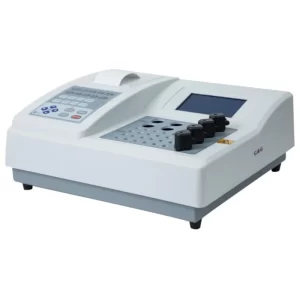
The AR-5004 Coagulation Analyzer is designed for laboratories that need higher parallel-testing capacity and stronger data-management functions. Its four channels support four parameters at the same time, while 24 sample and six reagent prewarming positions help operators prepare larger batches with fewer interruptions. The system also provides a 7-inch touch screen, storage for 10,000 results, QC functions, USB and RS232 connections, multilingual operation, and an optional barcode scanner.
Which ARI Model Fits Your Laboratory?
The three models follow a clear capacity path. You can choose by workload rather than appearance or screen size.
AR-5001 for Low-Volume Routine Work
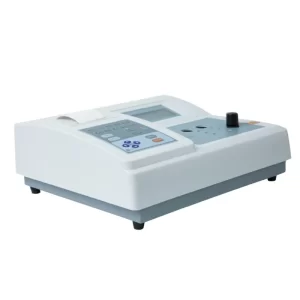
The AR-5001 Coagulation Analyzer is the practical starting point for a small clinic laboratory or a department with low daily volume. It uses one testing channel, with six sample prewarming positions and two reagent prewarming positions. It stores up to 10,000 results and includes a built-in thermal printer.
This model suits a team that values simple operation and does not need several tests running at once.
AR-5002 for Balanced Capacity and Cost
The AR-5002 Coagulation Analyzer moves to two testing channels and can analyze two parameters at the same time. It has 16 sample prewarming positions, three reagent prewarming positions, result storage, a built-in printer, and RS232 support for management software.
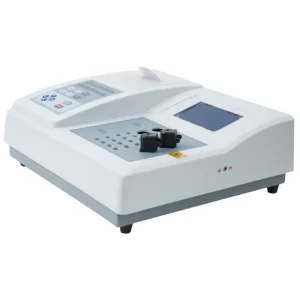
This is often a sensible middle choice for a small hospital lab or a growing diagnostic laboratory.
AR-5004 for Higher Throughput and Stronger QC
AR-5004 is the better fit when sample volume is higher, several tests need to run together, or your laboratory needs stronger data and QC functions. Its four-channel design reduces waiting, while the larger prewarming layout gives the operator more room to prepare a batch.
For hospital laboratories, project buyers, and distributors serving users with higher sample volumes, parallel-testing needs, and stronger QC requirements, this model may be a more suitable option.
What Cost Factors Matter Beyond Purchase Price?
The right Coagulation Analyzer should keep daily work steady without forcing the lab to pay for unused capacity.
Reagents, Labor, and Consumables
Ask for the published sample and reagent volumes for the exact model and test method. Small differences can affect annual reagent cost when sample numbers rise. Also check printer paper, pipettes, cuvettes, controls, calibrators, and model-specific accessories.
Labor matters too. A lower-priced device may need more manual recording, more sample waiting, or more repeated handling. Those steps belong in the cost calculation.
Data Handling and Future Growth
Check whether the interfaces fit your reporting process. A laboratory that only needs local printing has different needs from one that wants software transfer, barcode use, or stronger traceability.
Allow some room for growth, but keep the estimate realistic. Base the choice on actual sample records, seasonal peaks, new departments, and planned contracts.
What Should You Confirm Before Ordering?
Before the final quotation, send the supplier a clear requirement list. Include your daily and peak sample volume, routine and extended tests, preferred reagents, local voltage, reporting needs, language, order quantity, and target delivery date.
You should also confirm the standard configuration, optional items, installation responsibilities, user training, warranty terms, spare-part supply, troubleshooting process, and response time. ARI’s service scope includes product matching, installation guidance, operation support, and maintenance training.
A single-channel model suits low-volume work. Two channels give a growing laboratory a balanced step up. Four channels are easier to justify when parallel testing, stronger QC, and higher throughput are part of daily work. Choose a Coagulation Analyzer from the workload backward, not from the price list forward. For model confirmation, send ARI your laboratory requirements, including your daily and peak sample volume, routine test menu, preferred reagents, and reporting needs. This information will help the team recommend a suitable model, configuration, and service plan.
FAQ
Q1: What Should You Check First When Buying a Coagulation Analyzer?
A1: Check your routine tests, daily sample volume, peak workload, channel requirement, temperature control, repeatability, QC needs, reagent compatibility, and service support.
Q2: How Many Testing Channels Does a Small Laboratory Need?
A2: A low-volume clinic laboratory may work well with one channel, while a growing lab may need two. Four channels suit higher volume or several parameters running in parallel.
Q3: Which Routine Coagulation Tests Should Be Available?
A3: Most laboratories need PT, APTT, TT, and FIB, with additional factor tests selected according to the laboratory’s clinical work.
Q4: Why Is 37°C Temperature Control Important?
A4: Coagulation reactions are sensitive to temperature, so stable control helps reduce avoidable variation when combined with correct reagents, calibration, controls, and operator practice.
Q5: Which Model Is Better for a Laboratory That Expects Growth?
A5: AR-5002 is a balanced option for moderate growth, while AR-5004 suits higher volume, four-channel testing, stronger QC, and broader data management needs.