
Hospital Furniture Solutions: A Complete Guide to Planning and Procurement
Hospital furniture planning starts with a simple question: what does each room need to support safe, efficient care for patients and the staff who work there? Picking individual products from a catalog may be relatively straightforward but in reality ensuring that they fit into available space, support clinical processes and perform well as a collective set over the long term requires planning.
Hospital buyers must consider several key factors when purchasing products such as beds, bedside cabinets and overbed tables including product functionality, available room space, cleaning requirements and long-term maintenance requirements. Products designed for general ward beds may not be suitable for use in Intensive Care Units and items such as bedside cabinets and overbed tables must fit within the room and not impede nursing or patient access.
As a leading global supplier of medical equipment to hospitals with over 20 years of experience and support to a multitude of hospital departments, ARI has three manufacturing facilities based in China and supplies over 100 countries worldwide. ARI supplies the full range of products and in addition to this provides full installation guidance, operation training and on-going maintenance for new hospitals and also for hospital expansions. The services that ARI provide in relation to product selection can assist in simplifying the process of hospital procurement and also the project as a whole.
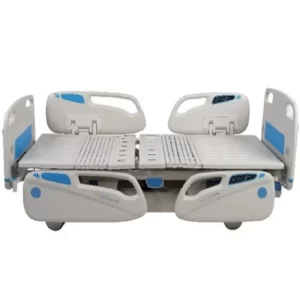
Why Hospital Furniture Planning Matters Before Procurement
Hospital furniture is constantly in use by patients and their visitors as well as by nurses, caregivers and other members of hospital staff. This means that in drawing up a purchasing plan for hospital furniture, due consideration must be given to clinical requirements and to the dimensions and layout of the room in which the furniture is to be used.
Match Furniture to Daily Clinical Work
Clinical departments have different needs with respect to furniture. The ICU staff requires beds that allow for frequent repositioning of patients and easy access for nursing care. The general wards on the other hand require simple operation, easy cleaning, durability and cost effectiveness.
Consider who will use equipment and how frequently items will be used. Items should allow for the level of adjustment required and consider whether a manually adjusted bed is suitable for particular care areas or if patients are to be repositioned frequently by staff during busy shifts.
Balance Patient Comfort and Nursing Efficiency
Patient comfort must be considered in conjunction with aspects of nursing, efficiency, safety and access.
Nurses must have sufficient space to approach patients and beds, as well as to move around beds and to bring in required equipment for nursing care. Bed controls must be easily reachable, side rails easily operable, and bed height as well as bed height range must be sufficient for required nursing care.
Several practical details need to be considered when assessing products for use in nursing and health care as well as when purchasing furniture for hospitals.
How to Plan Hospital Furniture for Different Care Areas
Match the furniture configuration with the clinical needs of the individual departments. The requirements of each department will differ, and as such the required bed functions, accessories, materials and degree of adjustability will also differ.
Choose Functional Beds for Intensive Care Units
Intensive care beds are used in critical care environments. Beds in these areas are positioned using set points, and manipulated by care givers on a regular basis for patient repositioning and for nursing care.
An electric hospital bed makes it easy for staff to move patients in the best position using the powered functions of the bed. In addition to the number of functions, potential buyers should also look at the control, the side rails, the braking system, the mobility of the bed and the backup power.
For ICU projects that need multiple powered adjustments, the ICU-5 5 Function Electric Hospital Bed (Luxury) could be a solution. The 5 electrically controlled functions are back-rest, leg-rest, bed-height, Trendelenburg and Reverse Trendelenburg.
Coordinate Furniture for General Wards
General wards need a different type of furniture than the intensive care units.
Hospital beds are just one item that may be required in a ward, along with bedside cabinets, overbed tables, mattresses, IV stands and medical trolleys to name a few items. Consideration must be given to the dimensions of the items and their positioning around the bed to allow for movement of staff and equipment. Consideration should also be given to the following: bedside storage, overbed-table clearance, surface cleaning and patient transfer.
Check the room dimensions and complete furniture layout before ordering any piece. Although something may look good on a floor plan, it can end up blocking a drawer, a door, equipment routes or patient transfer routes when installed.
What Should Buyers Consider When Selecting Hospital Furniture?
It is essential to identify the necessary equipment for the respective care areas prior to selecting hospital furniture and to compare the properties of the products with the corresponding clinical requirements. Although the product pictures give a first impression, the dimensions, adjustability, material, controls, load capacity, cleaning requirements and service offered are much more important for the application in a clinical environment.
Check Dimensions, Adjustment Range, and Materials
Measure the overall size of the bed to compare with the room, doors, lifts and route ways around the hospital, not just the size of the mattress or bed-board.
When purchasing an electric hospital bed, check the bed’s height adjustment range and the bed’s back-rest and leg-rest angles in various positions, including Trendelenburg. Also check for any linked or one-touch movements.
Review the materials used for the bed frame, bed platform, bed side rails, bed head board and bed foot board, etc. and how they can be frequently cleaned and disinfect.
Examine Safety Features and Ease of Operation
Assess ease of use for patients and healthcare professionals. Where necessary test for ability to lock specific patient functions to prevent accidental changes.
Braking system, side rails, mobility, access to head and foot ends of the patient and the bed’s specified load rating should be reviewed together and considered when determining if a bed is suitable for daily nursing care.
Compare More Than the Purchase Price
Low unit price does not necessarily translate into low life cycle cost for a product.
Find out what is included in the quoted price and which accessories are optional. Find out how you will be supplied with replacement parts and what maintenance, training, technical support and warranty terms and conditions will apply.
For very large orders, it is recommended to ask for a detailed specification sheet for each of the proposed models. A consistent format for the specifications allows for an easy comparison of equivalent models and for the detection of essential differences before the models are delivered.
How the ICU-5 Electric Hospital Bed Meets Intensive Care Needs
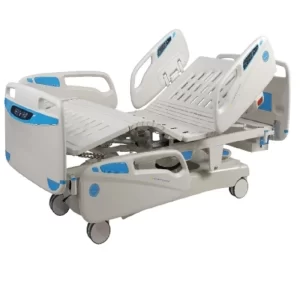
The ICU-5 offers a combination of 5 electric positioning functions, patient and nursing controls, side rails, emergency power and an electric central braking system, making it suitable for a number of intensive care applications.
Five Electric Functions for Patient Positioning
The ICU-5 bed provides 5 functions which are controlled electrically. These functions are: back-rest 0-65°, leg-rest 0-40°, bed-height 500-750 mm, Trendelenburg 0-12° and Reverse Trendelenburg 0-12°. The bed board is 1940 x 900 mm.
The bed features independent positioning for the head, backrest and legrest sections. The backrest and legrest sections also feature linked movement so both can be raised/lowered simultaneously as required.
A one-touch reset function returns the bed to a flat, lowest position from other settings.
These powered adjustments are made by nursing staff in order to efficiently reposition their patients, rather than having to manually reposition them.
Touch Controls for Patients and Nursing Staff
Hospital bed controls are frequently operated throughout the day. The ICU-5 is designed with touch switches instead of traditional mechanical keypads.
Touch controls are integrated into the two side rails at the head end for patient use. A separate touch-control system on the footboard allows nursing staff to operate the bed and includes a Patient Lock-Out function for restricting selected patient controls when required.
The indicator lights of the electric functions show their status of operation.
Verify during product evaluation that the control unit’s design is suitable for access by patients and for supervision by nurses in the respective care setting.
Protective Rails, Backup Power, and Braking
ICU-5 bed is made of steel frame with components made of ABS and PP. The four side rails of the bed are made of PP and drop down by gas spring. Head and foot boards of the bed are detachable made of PP. IV-pole mounting brackets are provided at all four corners of the bed frame.
A backup battery provides power when the mains power supply fails. The time the battery will last and the functions available on backup power should be checked to determine if it will be suitable for a particular application.
The bed is supplied on 150 mm universal castors and has an electrically operated central braking and release system. Manufacturer’s loading is less than 250 kg. It is essential that you verify the manufacturers formally declared loading capacity, against the Safe Working Load (SWL) where specified, prior to ordering.
The overall dimensions of the machine are 2240 mm (L) × 1050 mm (W). The bed height is between 500mm and 750mm. Please check the overall dimensions against doorways, lifts, corridors, room dimensions and the route that the machine will travel prior to placing orders for quantities and configurations.
How to Manage End-to-End Hospital Furniture Procurement
In addition to selecting the right product for hospital furniture, the successful completion of a procurement project also depends on the planning of delivery, installation, training, maintenance and after-sales service.
Prepare a Department-Based Purchasing Checklist
Create a separate furniture schedule for each department to review quantities and technical requirements.
Record product type, required quantity, necessary functions, dimensions, additional equipment etc. for each department. For electric hospital beds also record the power supply, the control, all positioning functions and the backup power required.
Mandatory technical requirements should be clearly distinguished from optional design preferences. In this way suppliers can provide more accurate cost offers and avoid changes that are not required after placing the order.
Confirm Delivery and Installation Requirements
Check packaged and assembled equipment for site delivery through the building’s access routes to designated rooms. Check door widths, lift capacity, corridors, turning space etc. and any site specific restrictions.
Packaging, shipping, unloading, local assembly, installation and final placing of the products must be clearly defined before delivery. For foreign countries like overseas hospitals, it must be clearly stated which tasks the supplier is responsible for and which tasks are to be performed by the local installation team.
It is much easier to resolve these details before shipping than to try to deal with access or installation problems once the equipment has arrived on site.
Plan Training, Warranty, and Maintenance
For electric hospital beds, operating instructions, basic service information and maintenance information for the selected model should be available.
We recommend you to check the warranty period and any exceptions as well as the availability of spare parts, the standard technical assistance and maintenance required by each model. The service offered may vary depending on the model’s configuration and the conditions of the order.
Please elaborate on how faults are reported and cleared, how spares are sourced, what technical documents are provided and who requires training for operation and/or maintenance of the equipment. ARI provides installation guidance, operation training and maintenance expertise on all our hospital equipment projects.
Conclusion: Bringing Hospital Furniture Planning and Procurement Together
When purchasing hospital furniture, it is important to start with a consideration of the rooms, users, clinical processes and site constraints. Furniture features and prices should then be considered against these requirements as opposed to in isolation.
The ICU-5 could be considered for projects that require powered positioning of the patient, as well as control by the patient or by the nurse, protection by side rails, a backup power supply and electric central braking. The 5 electric functions are back-rest, leg-rest, bed height, Trendelenburg position and Reverse Trendelenburg position.
ARI can assist in reviewing the required equipment for your hospital furniture procurement project. Whether it is to equip a completely new hospital, extend the ICU or re-equip general ward areas, ARI can suggest suitable configurations.
Please share your department list and the corresponding required quantities and technical details as well as the tender documents. We will provide you with a number of suitable products, detailed offers and information regarding installation and after sales service.
FAQ
Q1: What Furniture Should Be Included in a Hospital Ward Procurement Plan?
A1: Typical items found in a ward are hospital beds, bedside lockers, overbed tables, ward mattresses, IV stands and medical trolleys. The selection of furniture can vary depending on the department where it is to be used, and the resulting room configuration. Other factors include available space, cleaning and budget.
Q2: What Features Should Buyers Look for in an ICU Electric Hospital Bed?
A2: List all required electric functions of the bed for positioning, check height range and all angles of backrest and legrest. Check also Trendelenburg position, side rails, patient control and nurse control. Check also braking system and back up power. Check overall dimensions, weight capacity, materials and easy cleanability of all parts. Clinical and site requirements of the ICU must be met by exact configuration.
Q3: Are Electric Hospital Beds Suitable for Every Hospital Department?
A3: No, this is dependent on clinical department workflows and patient acuity. Some departments may require frequent repositioning and benefit from a multi-function electric bed whilst general wards may be suitably equipped with basic bed types.