
Ultrasound machines are usually compared in two ways: by imaging capability and by physical format. Imaging capability includes B-mode, M-mode, color Doppler, pulsed-wave Doppler, power Doppler, and other functions used for different examination needs. Physical format refers to whether the system is cart-based, laptop-style, or handheld wireless.
These two points should be separated when choosing equipment. A hospital may need basic grayscale imaging but still want a portable laptop unit. Another department may require color and spectral Doppler but prefer a cart-based system that stays in one examination room.
Probe options, storage, battery use, data export, and operator training also affect the final choice.
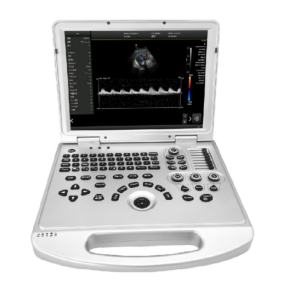
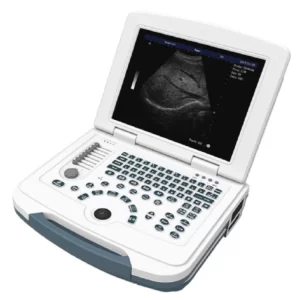
ARI Medical’s AR-9000C B/W laptop scanner, AR-K3 Color Doppler Ultrasound Scanner, and ARI-3in1 Wireless Ultrasound Scanner give three practical examples of grayscale imaging, Doppler capability, and mobile formats.
Types of Ultrasound Machines by Imaging Mode
Imaging mode decides what type of information the operator can obtain from an examination. This is more specific than simply dividing machines into “black-and-white” and “color” systems.
Common Ultrasound Imaging Modes Explained
B-mode provides two-dimensional grayscale anatomical images and is the basic mode used in many routine ultrasound examinations.
M-mode records motion over time along a single ultrasound line. It is useful when movement needs to be measured or followed rather than viewed as a still two-dimensional image.
Color Doppler adds a visual map of blood-flow presence and direction over the B-mode image. It helps the operator see where flow is occurring.
Pulsed-wave Doppler, often written as PW Doppler, provides spectral information that can be used to assess blood-flow velocity at a selected location.
Power Doppler is more sensitive to weaker or low-flow signals than standard color Doppler, although it does not provide the same directional information.
Tissue harmonic imaging, or THI, is another useful function on some systems. It can improve image quality in certain examinations by using harmonic signals generated in tissue.
Not every department needs all of these modes. The useful combination depends on the examinations actually performed.
B/W Ultrasound Machines
B/W ultrasound can support routine anatomical imaging and measurements in general examination, OB/GYN, urology, pediatrics, and other applications where Doppler flow assessment is not required.
The AR-9000C B/W Laptop Full Digital Ultrasound Scanner has a 12.1-inch display and supports B, B+B, 4B, B+M, and M modes. It also includes built-in storage, USB support, and a built-in lithium battery.
Its laptop format makes it easier to move between examination rooms, outpatient areas, smaller facilities, or mobile work where a full cart system is inconvenient.
Color Doppler Ultrasound Machines
Color Doppler systems are used when the examination needs more than grayscale anatomy.
B-mode still provides the anatomical image, while Doppler functions add different types of flow information. Color Doppler helps visualize blood-flow presence and direction. PW Doppler provides spectral velocity information. Power or directional energy Doppler can help detect weaker flow signals.
The AR-K3 Color Doppler Ultrasound Scanner supports B/W imaging, color imaging, spectral pulsed-wave Doppler, directional energy Doppler, tissue harmonic imaging, and real-time triple synchronization.
It can also work with convex, linear, transvaginal, micro-convex, rectal, and phased-array probe options. That wider probe range matters when one system needs to cover several examination types.
B/W vs Color Doppler Ultrasound: What Is the Difference?
B/W ultrasound mainly provides grayscale anatomical information and measurements. A Color Doppler ultrasound system adds Doppler functions for examinations where blood-flow presence, direction, or velocity needs to be assessed.
The decision should still come back to the actual examination list. A department doing routine anatomical scanning may not need a full Doppler package. Vascular or cardiac work, on the other hand, usually needs color and spectral Doppler functions.
Types of Ultrasound Machines by Physical Format
Physical format affects where the scanner can be used, how often it can be moved, and how staff work around it.
Cart-Based Ultrasound for Fixed Department Rooms
A cart-based ultrasound system works well in rooms where the scanner stays close to the same examination bed.
The larger body gives more space for controls, probe holders, printers, and other peripherals. Multiple probes can also remain connected or ready for use more easily.
The trade-off is mobility. A cart system can be moved, but it is less convenient for frequent bedside work or transport between buildings.
Laptop Portable Ultrasound Scanner for Bedside and Outreach Work
Laptop ultrasound scanners keep a dedicated display and control panel while reducing the size of the whole system.
A model such as the AR-9000C can be used in outpatient rooms, general examination areas, smaller facilities, and mobile work. One unit can cover several locations more easily than a full cart system.
Battery time, total weight, display visibility, protective carrying equipment, cleaning, and probe compatibility should all be checked before purchase.
Handheld Wireless Ultrasound for Fast Mobile Checks
The ARI-3in1 Wireless Ultrasound Scanner works with iOS, Android, and Windows phones or tablets.
Its double-head design combines convex or phased-array scanning with linear scanning. The system also supports color and Doppler-related modes, uses a replaceable battery, and can save images or video on the connected device.
This kind of format is useful for bedside checks, emergency work, outpatient use, outreach, and mobile screening where carrying a larger scanner would slow staff down.
Ultrasound Machine Type Comparison Tables
The imaging capability and the physical format should be compared separately. One tells you what the machine can show. The other tells you how the equipment fits into daily work.
Comparison by Imaging Mode
| Imaging Type | What It Shows | Typical Use | Main Buying Concern |
| B/W ultrasound | Grayscale anatomy, B-mode, B+M, M-mode | Routine anatomical imaging and measurement where Doppler flow assessment is not required | Cost, probe choice, measurements |
| Color Doppler ultrasound | Grayscale imaging plus color flow, PW Doppler, and other Doppler functions depending on configuration | Vascular, cardiac, OB/GYN, and other examinations where flow assessment is required | Doppler functions, probe set, training |
The table should not be read as “one department equals one machine type.” The same OB/GYN or general examination department may use either B/W or Doppler functions depending on its examination protocol.
Comparison by Physical Format
| Format | Portability | Typical Use | Main Buying Concern |
| Cart-based ultrasound | Low | Fixed examination rooms | Room space, probes, peripherals |
| Laptop ultrasound | High | Bedside, clinic, outreach | Battery, screen, weight, data export |
| Handheld ultrasound | Very high | Rounds, emergency, mobile screening | Device compatibility and cleaning |
Once the imaging modes are clear, the physical format can be matched to transport frequency, room layout, battery use, device compatibility, and storage workflow.
Which Ultrasound Machine Fits Each Department?
General examination rooms often need dependable grayscale imaging, common measurements, and a practical probe set. OB/GYN work may require convex and transvaginal probes, while the need for Doppler depends on the examination protocol.
Vascular examinations usually require color and spectral Doppler functions with a linear probe. Cardiac work normally needs Doppler capability and a phased-array probe. Emergency and mobile services may place more weight on portability, battery use, and fast setup.
| Department or Use | Imaging Need | Probe Requirement to Confirm |
| General examination | Routine B/W or Doppler depending on examination | Convex |
| OB/GYN | B/W or Doppler depending on protocol | Convex plus transvaginal where required |
| Vascular | Color and spectral Doppler | Linear |
| Cardiac | Doppler functions | Phased-array |
| Mobile/bedside | Depends on the examination | Portable-compatible probe set |
Confirm Each Department’s Protocol
Before ordering, make a simple list of planned examinations.
For each one, note the required probe, imaging mode, room location, battery expectation, storage method, print or export requirement, and staff training need.
This avoids treating a department name as a fixed ultrasound configuration. Two hospitals may both have an OB/GYN department, but the required machine setup can still be different.
How to Check Probes, Portability, and Data Workflow
A machine can have the right imaging modes and still be a poor fit if the probe package or data workflow does not match daily use.
Confirm the Probe Package
Probe selection can decide whether a scanner is actually usable for the planned work.
Check whether convex, linear, transvaginal, micro-convex, phased-array, or other required probes are standard or optional. Frequency range, connector count, cleaning method, replacement availability, and storage also matter.
A long function list is not very helpful if the probe needed for a common examination is missing from the package.
Test the Handover of Images
Staff should be able to save an image, retrieve a case, export it, and move it into the department’s normal reporting process without too many extra steps.
Check still-image storage, cine review, USB export, DICOM where required, device compatibility, and report transfer.
ARI Medical’s solutions and service resources can also be used when discussing equipment configuration, installation, training, and later service needs.
Compare Portable and Full-Size Systems in Daily Use
Portable ultrasound reduces transport and setup work. A full-size cart system usually gives the operator more control space, a larger display, and easier access to several probes.
Neither format is automatically the better one.
A department that scans mainly in one room may get more value from a cart system. A team moving between wards or clinics may benefit more from a laptop or handheld unit.
Conclusion
Ultrasound machines are easier to compare when imaging capability and physical format are treated as two separate decisions.
B-mode and M-mode cover basic grayscale imaging and motion display. Color Doppler, PW Doppler, and power Doppler add different types of flow information. Cart-based, laptop, and handheld systems then solve different mobility and workflow needs.
Probe coverage, battery use, storage, export, cleaning, training, and service still need to match the actual examination list.
For final configuration, share the planned examinations, required probes, room conditions, and data workflow with the ARI Medical contact team.
FAQ
Q1: What Are the Common Types of Ultrasound Machines?
A1: Ultrasound machines can be classified in two main ways. By imaging capability, common options include B/W ultrasound and Color Doppler ultrasound, with modes such as B-mode, M-mode, color Doppler, PW Doppler, and power Doppler. By physical format, common systems include cart-based, laptop-style portable, and handheld wireless ultrasound devices.
Q2: What Is the Difference Between B/W and Color Doppler Ultrasound?
A2: B/W ultrasound mainly provides grayscale anatomical information. Color Doppler systems add flow-related functions, while PW Doppler can provide spectral velocity information and power Doppler can help detect weaker flow signals.
Q3: Is a Portable Ultrasound Scanner Suitable for Mobile Clinics?
A3: Yes, if the battery, weight, screen, portable-compatible probe set, storage, and data export fit the mobile clinic workflow.
Q4: When Should a Facility Choose Handheld Ultrasound?
A4: Handheld ultrasound is useful when portability, bedside access, mobile screening, and device-based storage matter more than a large console and fixed controls.
Q5: Which Details Should Be Checked Before Buying Ultrasound Equipment?
A5: Check imaging modes, probe types, probe frequency ranges, display, battery, weight, storage, data export, cleaning workflow, operator training, warranty, and service support.