
A mobile digital radiography system should be selected by where it needs to move, which bedside examinations it must handle, how easily the tube and detector can be positioned around patients, and how images enter the hospital’s DICOM/PACS workflow. Wards, emergency rooms, operating rooms, and ICU areas use mobile X-ray in different ways. The right model is the one that fits the hardest positioning and workflow conditions, not simply the one with the highest generator rating.
For bedside procurement, check generator and tube capacity, detector size, wireless acquisition, image time, mechanical travel, turning and positioning range, workstation functions, DICOM integration, delivery access, power requirements, cleaning workflow, service, training, and acceptance testing. If battery-powered exposure is part of the project, confirm the battery configuration and expected runtime before ordering.
ARI Medical’s Hospital DR System Buying Guide 2026 gives a useful fixed-room reference for generator power, detector performance, DICOM integration, room planning, and ownership cost. For mobile bedside work, the ASH-3200 Mobile Digital Radiography X-ray System is designed for wards, emergency rooms, operating rooms, ICU, and other hospital areas.
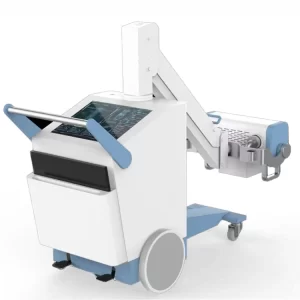
Which Care Area Should Define the Mobile DR Specification?
List the departments that will share the machine and identify the hardest movement or positioning case in each one. A mobile unit that moves easily through an open ward corridor may be much harder to use beside ICU ventilators, infusion pumps, monitors, or an operating table.
| Care Area | Typical Workflow Priority | What to Confirm | Main Purchasing Risk |
| General ward | Routine bedside chest and limb imaging | Easy movement, detector handling, quick setup | Buying more system complexity than the ward needs |
| Emergency room | Fast repositioning and varied examinations | Generator range, detector, tube movement, image availability | Slow setup during peak demand |
| ICU | Positioning around beds and life-support equipment | Tube height and rotation, detector placement, DICOM transfer | Mechanical range blocked by bedside equipment |
| Operating room | Controlled positioning and image workflow | Collimator and tube rotation, cleaning, workstation access | Poor fit with room layout or sterile workflow |
Start With the Most Constrained Bedside Position
For ICU or emergency use, map the bed, rails, ventilator, pumps, monitor, wall outlets, carts, and normal staff positions. Check which side the mobile unit can approach from and whether the detector can be placed without repeatedly moving the patient.
This simple check often tells you more than testing the unit in a large open demonstration area.
Match the Examination Range to the Departments
The ASH-3200 is intended for imaging the head, limbs, chest, waist, abdomen, and other body parts. For a machine shared across several departments, the hospital should still define its own examination protocols and positioning needs before placing an order.
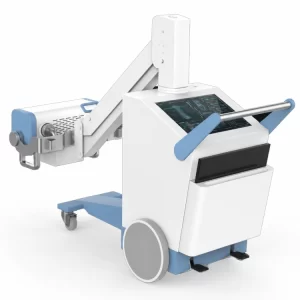
How Much Mechanical Mobility Does Bedside Imaging Need?
Mechanical movement matters because bedside imaging rarely happens in an empty space. Beds, rails, monitors, pumps, oxygen equipment, and other devices may all limit where the operator can place the tube.
Check Tube Height, Folding, Tilt, and Rotation
The ASH-3200 uses a folding-arm tube support. Its tube-focus height ranges from 480 to 1700 mm from the ground. The arm folds from -45° to +45°, tube tilt is ±45°, tube vertical rotation is 360°, and collimator axial rotation is ±360°.
These ranges help when the operator needs to reach over a bed, work around nearby equipment, or change the projection without moving the patient more than necessary.
Treat the Wireless Detector as a Separate Workflow Tool
The system uses a 14 × 17-inch amorphous-silicon WiFi flat-panel detector with a cesium-iodide scintillator.
A wireless detector gives more freedom when placing it under or beside a patient, but daily use also depends on charging, cleaning, handling protection, pairing, drop risk, replacement planning, and the local wireless environment.
Check Doorways, Turning Space, and Storage
Do not assume that a mobile DR trolley will fit every corridor, elevator, storage point, or bedside approach.
Where access is tight, confirm the current overall dimensions and movement requirements for the selected configuration before shipment. Check the delivery route, elevator size, door width, storage location, and the actual approach to the beds where the machine will be used.
Which Imaging Specifications Matter Most in a Mobile DR System?
Generator power matters, but it should be reviewed together with the tube, detector, examination mix, and expected daily workload.
Generator and X-Ray Tube Capacity
The ASH-3200 uses a 32 kW high-frequency generator with a 40–125 kV voltage range, 10–400 mA current range, 0.1–320 mAs range, and 1–10,000 ms exposure time.
The rotating-anode tube has 140 kHU anode heat storage and maximum anode heat dissipation of 475 W. These figures help the procurement team check whether the system fits the expected examination range and repeated-use pattern.
Detector Size, Resolution, and Acquisition Time
The 14 × 17-inch detector has a 2304 × 2800 active-pixel matrix, pixel pitch of no more than 150 μm, 16-bit A/D conversion, DQE of at least 70%, spatial resolution of 36 Lp/cm, and acquisition time of no more than two seconds.
These numbers should not be compared on their own. Sample images, exposure practice, image processing, clinical protocol, and the hospital’s own acceptance criteria also matter.
Do Not Reduce Image Quality to One Number
Pixel pitch, DQE, detector material, spatial resolution, generator stability, positioning, exposure technique, and image processing all affect the final result.
A smaller pixel-pitch number alone does not guarantee a better bedside image if poor positioning or an awkward workflow causes repeated exposures.
How Should Mobile DR Connect to the Hospital Workflow?
A mobile system still needs to work as part of the hospital imaging network. Delays often come from patient registration, image routing, or network setup rather than from the exposure itself.
Confirm DICOM and PACS Integration Before Delivery
The ASH-3200 workstation supports DICOM 3.0 query functions for PACS integration.
Before delivery, confirm patient-registration methods, worklist requirements, image routing, storage destinations, printer use, network security, and responsibility for interface setup. Leaving these points until commissioning can slow down an otherwise functional system.
Review the Workstation, Not Only the X-Ray Hardware
The workstation supports patient registration, radiographic examination setup, image display, analysis, processing, output, data management, and component calibration. The system uses a 19-inch LCD touch screen.
For bedside work, operators should be able to move from patient selection to exposure, image review, and transfer without unnecessary repeated data entry.
Build Acceptance Testing Around Your Real Workflow
Before final handover, test the system on the hospital network. Check detector communication, image transfer, user accounts, worklist behavior where required, and routine operator tasks.
Training should also cover positioning, image review, cleaning, fault messages, shutdown, and storage. Acceptance testing should reflect the way the system will actually be used, not only whether the generator powers on.
What Should Hospitals Confirm Before Ordering?
Several project details should be settled before production or shipment rather than after the machine reaches the hospital.
Power, Mobility, and Site Conditions
Provide the target departments, typical examinations, busiest daily period, corridor and elevator restrictions, storage point, local voltage, network requirements, and detector-handling expectations.
Battery-powered configurations may vary by project. If off-mains exposure is required, confirm the battery configuration and expected runtime with ARI Medical before ordering.
Training, Service, and Spare Parts
Confirm installation responsibilities, operator training, detector and workstation support, replacement parts, software support, and maintenance arrangements.
Warranty terms, response procedures, service scope, and local responsibilities should be written into the quotation or purchase contract. ARI Medical’s current service support information can also be reviewed during procurement.
Compare Mobile DR With Fixed DR Only When the Workflow Requires It
A mobile unit solves bedside access and movement problems. A fixed DR room serves a different positioning and room workflow.
If the hospital is deciding between them, compare department volume, patient transport burden, generator requirements, detector workflow, room preparation, and DICOM integration. The Hospital DR System Buying Guide 2026 can be used as the fixed-room reference.
Conclusion
A mobile digital radiography purchase should start with the hardest bedside workflow.
Map the care areas, patient positions, surrounding equipment, detector placement, tube movement, network connection, and delivery route before comparing price.
The ASH-3200 combines a 32 kW generator, 14 × 17-inch WiFi flat-panel detector, flexible tube and collimator movement, a digital workstation, and DICOM 3.0 integration. Those specifications are useful only when they fit the ward, emergency room, ICU, or operating-room workflow the hospital actually needs.
FAQ
Where Is Mobile Digital Radiography Commonly Used?
Mobile DR is commonly used in wards, emergency rooms, ICU areas, operating rooms, and other hospital locations where moving the patient to a fixed X-ray room is difficult or inefficient.
What Mechanical Specifications Matter for Bedside X-Ray?
Check tube-focus height, arm movement, tube tilt and rotation, collimator rotation, detector placement, trolley dimensions, turning space, and the approach around beds and other equipment.
What Detector Does the ASH-3200 Use?
The ASH-3200 uses a 14 × 17-inch amorphous-silicon WiFi flat-panel detector with a cesium-iodide scintillator, 2304 × 2800 active pixels, ≤150 μm pixel pitch, 16-bit A/D conversion, and ≤2-second acquisition time.
Why Does DICOM Matter for Mobile DR?
DICOM integration helps patient and image data move through the hospital imaging workflow. PACS connectivity, worklist needs, storage, network responsibilities, and acceptance testing should be confirmed before installation.
What Should You Confirm About Battery Operation?
If battery-powered exposure or off-mains operation is required, confirm the selected battery configuration, expected runtime, charging requirements, and project setup before purchase. Do not assume that every mobile DR configuration uses the same battery arrangement.
For project-specific configuration or ordering details, contact ARI Medical before finalizing the system.