
Choosing a portable ventilator for ambulance transport involves more than comparing a list of ventilation modes. Emergency medical services (EMS), hospitals and medical equipment distributors must assess whether a device can maintain appropriate respiratory support during patient preparation, loading, vehicle movement and handover.
Four specifications provide a practical starting point: ventilation modes, ventilation parameter ranges, battery runtime and oxygen supply requirements. They should be reviewed together with the device’s approved intended use, alarms, transport mounting and local clinical protocols.
How Transport Conditions Affect Ventilator Selection
Unlike a stationary treatment area, an ambulance may have changing power availability, limited oxygen reserves, vibration and frequent equipment transfers. Some ICU ventilators also include backup batteries, but their power requirements, size and transport certification differ by model. A dedicated transport ventilator should be evaluated for the specific vehicle and patient-transfer workflow rather than assumed to outperform or replace an ICU unit.
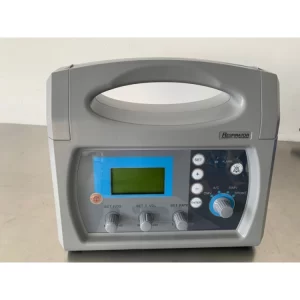
For example, ARI Medical lists the AR-20 portable ventilator at 220 × 220 × 170 mm, with a carrying/mounting handle and a stated operating temperature range of −18°C to +50°C. The same listing states IPX4 splash resistance. Purchasers should confirm mounting hardware, environmental test conditions and the configuration supplied before deployment.
Four Key Specifications for a Transport Ventilator
1. Ventilation Modes
Ventilation modes determine how mandatory and patient-triggered breaths are delivered. CMV provides mandatory breaths using preset settings; assist/control (A/C) permits supported breaths initiated by patient effort; and synchronized intermittent mandatory ventilation (SIMV) coordinates mandatory breaths while allowing spontaneous breathing between them. SPONT denotes spontaneous breathing operation, although the available assistance depends on the specific device.
The AR-20 is listed with CMV, A/C, MANUAL and CPR. MANUAL refers to an operator-initiated breath using the device controls; it should not be described as manual bag-valve ventilation. CPR is a manufacturer-specific mode whose operation must be checked in the instructions for use. The AR-100C portable ventilator is listed with CMV, A/C, SIMV and SPONT. The appropriate selection depends on the patient’s ventilation needs and the clinical team’s ability to use the available functions, not on transport distance alone.
2. Ventilation Parameter Ranges
Mode names do not describe the full range of ventilation that can be delivered. The AR-20 product information specifies a minute ventilation range of 3–20 L/min and a respiratory rate of 5–40 breaths/min. The AR-100C specifies a tidal volume range of 50–1,200 mL and a respiratory rate of 5–60 breaths/min. These are different control specifications and should not be treated as directly interchangeable.
For a set tidal volume and set respiratory rate, the nominal minute ventilation is their product. Delivered or measured values may differ with circuit leakage, patient-triggered breaths and device control behavior. Buyers should therefore check the actual operating ranges, triggering response, pressure monitoring and alarm behavior rather than infer clinical suitability from a single number. The AARC patient–ventilator assessment guideline also emphasizes systematic evaluation of ventilator settings and patient response.
Positive end-expiratory pressure (PEEP) is a ventilation setting, not a separate ventilation mode. The AR-20 listing gives PEEP as 0.5–20 hPa. The AR-100C listing gives 0–2 kPa but also identifies some PEEP-related configurations as supplier-dependent, so the actual supplied functionality should be confirmed. Overpressure relief and high-pressure alarms are distinct protective features: AR-20 documentation lists mechanical relief at ≤72 hPa, while AR-100C documentation lists a high-pressure alarm limit of 2–6 kPa. These figures should not be compared as though they represent the same mechanism.
3. Battery Runtime
A transport ventilator may need power during preparation, transfer to the vehicle, the ambulance journey, unloading and admission. The manufacturer lists an internal lithium-battery operating time of more than eight hours for the AR-20 and approximately eight hours for the AR-100C. Both figures are nominal claims rather than guaranteed runtime under every set of conditions.
Actual endurance can depend on device settings, ambient temperature, battery condition and connected electrical loads. Procurement teams should request the test conditions for each quoted runtime, calculate the longest expected interval without external power and retain an appropriate operational reserve. They should also confirm vehicle power compatibility, charging procedures, low-battery alarms, replacement-battery availability and maintenance requirements.
4. Oxygen Supply Requirements
Battery life and oxygen endurance are separate constraints. The AR-20 product information specifies a medical oxygen inlet pressure of 0.28–0.6 MPa, while the AR-100C specifies 0.4 MPa. These are equipment-specific requirements; cylinder regulators, connectors and hoses must match the selected model and the local medical gas system.
The AR-20 offers Air Mix and No Air Mix options. Mixing ambient air with the oxygen supply may reduce oxygen consumption, but the resulting oxygen concentration and suitability depend on device performance and the patient’s prescribed requirements. The AR-100C lists an oxygen concentration range of 45%–90%, subject to the supplied configuration and operating conditions.
The AR-100C product listing mentions a portable oxygen-cylinder option, but cylinder capacity and accessory descriptions are not fully consistent. A fixed “one-hour cylinder” claim is therefore inappropriate. Actual endurance depends on usable cylinder gas volume, pressure, device gas consumption and ventilation settings. Purchasers should obtain model-specific oxygen-consumption data and calculate a reserve for delays and emergencies.
ARI AR-20 vs. AR-100C: Specification Comparison
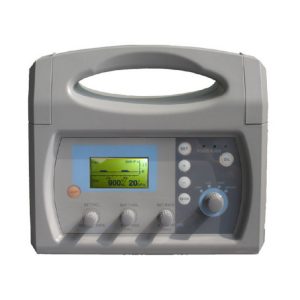
The AR-20 is positioned around essential emergency and transport ventilation controls, a compact housing and an easily accessible display. The AR-100C provides additional modes and separately specified tidal volume, trigger and oxygen concentration controls. Neither device should be selected from its headline specifications alone; the applicable instructions for use and exact configuration determine what is available.
| Specification | AR-20 | AR-100C |
| Ventilation modes | CMV, A/C, MANUAL, CPR | CMV, A/C, SIMV, SPONT |
| Primary listed volume range | Minute ventilation: 3–20 L/min | Tidal volume: 50–1,200 mL |
| Respiratory rate | 5–40 breaths/min | 5–60 breaths/min |
| PEEP (manufacturer listing) | 0.5–20 hPa | 0–2 kPa; confirm supplied option |
| Oxygen delivery/control | Air Mix / No Air Mix | O₂ concentration: 45%–90% |
| Medical oxygen inlet pressure | 0.28–0.6 MPa | 0.4 MPa |
| Nominal internal battery runtime | More than 8 hours | Approximately 8 hours |
| Operating temperature | −18°C to +50°C | +5°C to +40°C |
| Transport profile | Emergency response and patient transport | Transport requiring additional control options |
Note: Figures above reproduce manufacturer-listed specifications; they have not been independently tested. The AR-100C listing contains supplier-dependent PEEP information. Confirm the latest instructions for use, options, regulatory status and battery/oxygen test conditions before procurement.
Patient Suitability and Procurement Checks
Portable transport ventilators should not automatically be used as substitutes for full-featured ICU ventilators. Selection depends on the level of respiratory support, airway monitoring and clinical supervision required. The AR-20 marketing specification mentions patients above 5 kg, but the authorized patient population must be verified against the applicable labeling and instructions for use. Neonatal and pediatric use requires particular attention to low-volume delivery, trigger sensitivity, circuits and alarms.
For ambulance fleets and distributors, the purchasing review should also cover compatible breathing circuits, mounting systems, connectors, servicing arrangements, training materials and availability of consumables. Circuit interchangeability between models should not be assumed. ARI Medical’s service policy provides an additional starting point for discussing support terms, while the final agreement should specify the parts and services included.
Request Specifications and a Quotation
ARI Medical offers portable ventilator options for emergency services, ambulance installations and in-hospital patient transport. Buyers comparing the AR-20 and AR-100C can review the broader ARI Medical product range and request configuration-specific documentation rather than relying on summary specifications alone.
For pricing, technical files or distributor enquiries, contact ARI Medical with the intended patient population, required ventilation parameters, oxygen source, vehicle power arrangements and expected transport workflow. This information supports a more accurate equipment recommendation and quotation.
FAQ
Q1: Can a portable ventilator be used in a small hospital?
A1: Yes, when the intended clinical application is covered by the approved labeling and the device provides the required ventilation and monitoring capabilities. Patients needing advanced or prolonged intensive care may require an ICU ventilator and additional monitoring equipment.
Q2: What is the difference between minute ventilation and tidal volume?
A2: Tidal volume is the volume of gas delivered in a breath. Minute ventilation describes total ventilation over one minute, typically related to tidal volume and respiratory rate. The control method and actual delivered values are device-dependent.
Q3: How much battery runtime does an ambulance ventilator need?
A3: The minimum practical runtime depends on the total period without reliable external power, expected delays and an appropriate safety reserve. Nominal manufacturer claims should be checked against the actual device configuration and battery test conditions.
Q4: Can a transport ventilator operate without a hospital oxygen pipeline?
A4: It can if the device is designed for use with a compatible portable medical oxygen source. Before deployment, confirm inlet pressure, regulator and connector compatibility, cylinder capacity, expected oxygen consumption and available backups.
Q5: What should a distributor ask before purchasing transport ventilators?
A5: Request the current instructions for use, device configuration, patient-use indications, mode and alarm specifications, oxygen requirements, battery test data, regulatory documents, training arrangements and details of consumables and service support.