
A surgical light rated at 150,000 lux can look like a strong choice on a quotation. But will it light the working area evenly? Can the surgical team position it without blocking other equipment? And will the mounting system fit your operating room? Those questions matter just as much as the headline number.
When buying an LED surgical light, compare illuminance, illumination depth, field size, shadow control, color rendering, and installation requirements together. A high central lux reading cannot make up for a poorly matched light field or an arm that is difficult to position.
Why 150,000 Lux Is Only the Starting Point
Lux measures how much visible light reaches a surface. On a surgical-light specification sheet, the central illuminance value normally refers to a stated working distance. If two suppliers use different measurement distances, the numbers are not directly comparable.
Check Illumination Depth and Light-Field Size
Depth matters when the surgical field extends below the surface. However, a listed illumination depth does not mean the same brightness is maintained at every point along that distance. The measurement depends on the test method and the illuminance threshold used.
The YD02-LED5 is listed with 600 mm illumination depth and an adjustable 100–240 mm light field. The adjustable field lets the team match the illuminated area to the work being performed. Before you order, ask for the test definition, working distance, and field-uniformity information.
Look Beyond the Center of the Beam
A person, instrument, or overhead device can interrupt part of the light. That is why shadow dilution deserves its own check. Ask how the light performs with obstructions in place, not just when the beam is unobstructed. A demonstration in a room layout similar to yours can reveal problems that a peak lux figure will not show.
Color Rendering and Irradiance Need Separate Checks
Good surgical lighting is not only about brightness. The team also needs useful color information, while the hospital must assess radiant energy at the working area.
What Ra 96 and 4,800 K Mean
The YD02-LED5 specification lists a color rendering index (CRI) of Ra 96 and a color temperature of 4,800 ± 300 K. Ra describes the light’s general color-rendering performance against a reference source. It is useful, but it does not tell you everything about the reproduction of deep red tones.
If accurate tissue-color appearance is important to your purchasing requirements, ask about red rendering, color consistency, and how the light behaves at different brightness settings. Do not assume those results remain identical across the full dimming range.
Why 555 W/m² Is Not a Tissue-Temperature Reading
The listed total irradiance is 555 W/m². Irradiance describes radiant power reaching a surface per unit area; it is not a direct measurement of tissue temperature. Actual heating depends on conditions such as exposure time, absorption, and airflow.
Rather than accepting a broad claim that an LED lamp produces no heat, request the relevant test results. This gives the procurement team a sounder basis for comparing products.
Put the YD02-LED5 Specifications in Context
The YD02-LED5 LED Operating Lamp range offers a useful starting point for comparing clinical requirements with physical and electrical specifications. The figures below refer to the single-head YD02-LED5 configuration; confirm the current version before purchasing.
| Specification | YD02-LED5 (single-head) | What to Verify |
| Central illuminance | ≥150,000 lux | Measurement distance and test conditions |
| Light-field diameter | 100–240 mm, adjustable | Field size and uniformity at working distance |
| Illumination depth | 600 mm | Test definition and applicable threshold |
| Total irradiance | 555 W/m² | Test setup and radiant exposure conditions |
| Color temperature / CRI | 4,800 ± 300 K / Ra 96 | Color consistency and performance when dimmed |
| Installation height | From 2,500 mm | Ceiling compatibility, support, and arm reach |
| LED service life | 50,000 hours | Lifetime definition, warranty, and service options |
These values should be read as a set. For example, a 600 mm illumination depth is more useful when you also know the field diameter, brightness uniformity, and shadow behavior. The same applies to a 50,000-hour LED rating: it says nothing by itself about the service life of the driver, arm, or controls.
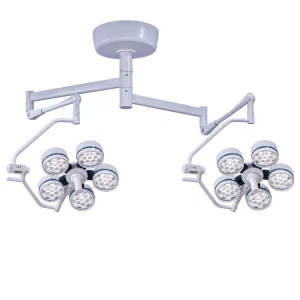
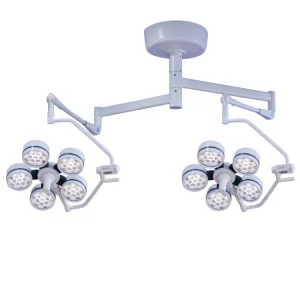
If you are considering a two-head arrangement, compare the YD02-LED5+5 LED Operating Lamp separately. Its published installation height and total power consumption differ from the single-head figures. The head count should follow the room layout and the team’s positioning needs, not a preference for more fixtures.
Check Installation before Choosing a Configuration
A surgical lamp may meet the optical requirements yet still be difficult to install. The ceiling, table position, and surrounding equipment must all be considered before a purchase order is approved.
Ceiling Height, Mounting, and Arm Movement
The single-head YD02-LED5 specification lists a minimum installation height of 2,500 mm. That figure is not a substitute for a mounting drawing or a structural assessment. You still need to confirm the finished ceiling height, mounting support, arm reach, rotation clearance, and the position of nearby equipment.
For rooms with medical pendants, monitors, or other ceiling-mounted systems, check possible arm collisions throughout the full movement range. A scaled room drawing is more helpful than relying on photos of the lamp alone.
Electrical Supply and Practical Maintenance
The single-head configuration lists AC 110–240 V, 50/60 Hz and 100 W total power consumption. Confirm these ratings for the version on your quotation, along with grounding and local electrical requirements.
Its 50,000-hour LED life is a source-life rating, not a promise of maintenance-free operation for 20 years. LED modules, drivers, suspension parts, and controls have different service needs. Ask about replacement parts, cleaning instructions, handle sterilization requirements, and warranty coverage before finalizing the order.
Choose a Supplier Who Can Support the Installation
A surgical light is not a stand-alone purchase in the same way as a small portable instrument. Delivery, ceiling preparation, fitting, commissioning, and later servicing all need clear responsibilities.
With more than 20 years of medical-equipment experience, ARI supplies operating-room equipment and works with hospital buyers and distributors on larger projects. Its service support covers technical and after-sales needs, with the specific terms to be checked for each product and order.
When requesting a quotation, send the room dimensions, finished ceiling height, ceiling structure, operating-table location, nearby pendant positions, desired number of light heads, and local electrical supply. Ask for a current technical sheet, mounting drawings, test documentation, warranty terms, and a clear list of included accessories.
The right LED surgical light is the one that meets your lighting requirements and works in the actual room. To review a proposed configuration and delivery needs, contact the team with your project details.
FAQ
Q1: Is 160,000 Lux Always Better Than 150,000 Lux?
A1: No. Compare the measurement distance, field uniformity, illumination depth, shadow dilution, and adjustment range before deciding. A higher central illuminance reading alone does not guarantee better lighting across the working area.
Q2: Does a 600 mm Illumination Depth Mean Constant Brightness at 600 mm?
A2: No. Illumination depth is defined using a test method and illuminance threshold. Ask the supplier for the applicable definition rather than treating it as a guarantee of uniform brightness at every depth.
Q3: Why Should Buyers Check Color Rendering as Well as Lux?
A3: Lux indicates the amount of visible light reaching a surface, while color rendering describes how colors appear. Ra is useful, but red rendering and color consistency can also matter when comparing surgical lights.
Q4: Does a 50,000-Hour LED Rating Mean the Whole Lamp Lasts That Long?
A4: No. That rating relates to the LED source under specified conditions. The driver, arm, controls, and other parts may need servicing or replacement earlier. Check the warranty and spare-parts arrangements separately.
Q5: What Should a Hospital Provide When Requesting a Surgical Light Quotation?
A5: Provide the operating-room dimensions, finished ceiling height, mounting details, table location, nearby ceiling equipment, electrical supply, and preferred head configuration. Layout drawings or photos can help the supplier assess installation requirements.