
Hospitals comparing electrosurgical units usually need to know which cutting and coagulation modes are available, how much output each mode provides at its stated load, and which safety features and accessories are included. A headline wattage alone cannot answer those questions.
A useful comparison starts with the department’s case mix. Routine open surgery, endoscopy, and urology may call for different settings, connections, and accessories. The specification sheet should make those differences clear before quotations are compared.
What the Generator Actually Does
Monopolar and Bipolar Current Paths
An electrosurgical generator converts mains power into high-frequency energy and shapes it into waveforms for cutting or coagulation. In monopolar mode, current travels from the active electrode through the patient’s tissue and returns through a dispersive electrode, also called the patient return electrode. Pad size, placement, and skin contact therefore matter.
Bipolar output follows a shorter path: current passes from one forceps jaw, through the tissue held between the jaws, and back through the other jaw. It does not use a separate return pad. Monopolar output is common for cutting and broader coagulation; bipolar instruments are used for more localized work.
Check that the unit has the monopolar and bipolar sockets, controls, and settings required by the department’s instruments.
Compare Working Modes and Output Ratings
Read Power with Its Load
Mode count is only a starting point. Pure cut, blend settings, spray coagulation, forced coagulation, soft coagulation, and bipolar modes use different waveforms. A longer list helps only when those modes match the department’s procedures.
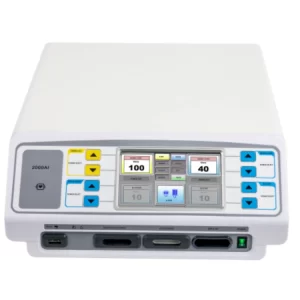
The ESU-2000AI (LCD) is listed with a maximum output of 400 W and nine working modes. At an 800 Ω load, pure cut reaches 400 W, Blend 1 reaches 300 W, Blend 2 reaches 200 W, and Blend 3 reaches 150 W. Spray Coag reaches 80 W; Forced and Soft Coag each reach 120 W. Bipolar coagulation and bipolar cut are each listed at up to 120 W at a 200 Ω load. These limits apply to the specified model and mode, not to every output.
Always compare output with its load resistance. A rating at 800 Ω cannot be compared directly with one at 200 Ω. Frequency and duty cycle matter too. The ESU-2000AI (LCD), for example, lists 512 kHz monopolar and 1024 kHz bipolar output. Request the complete table for the exact model.
Check the Exact Coagulation Modes
Coagulation modes need a closer look. Contact Coag, Spray Coag, Forced Coag, and Soft Coag are not labels to treat as interchangeable. Compare the exact mode name and power range shown for the quoted model, and ask the supplier to confirm any difference between the feature list and output table.
Check Safety Features and Standards
Return Electrode Monitoring and Power Peak
Return Electrode Monitoring (REM) monitors the contact condition of the dispersive electrode during monopolar use. If contact becomes inadequate, the system may alarm and limit or interrupt output, depending on its design. REM can reduce return-pad burn risk, but correct skin preparation, pad placement, and setup checks remain necessary.
Power Peak System is listed on selected ARI Medical units. Ask how it works, which models include it, and what test data supports its stated benefit. The name alone does not establish its control method or guarantee the same tissue effect at a lower setting.
Defibrillation Protection and Compliance Documents
Over-voltage and over-current protection address electrical faults. Defibrillation protection concerns the unit’s ability to withstand conditions associated with defibrillator use; it does not block the shock from reaching the patient. Confirm the model’s protection features and test documents.
Request the declaration of conformity and applicable test reports. IEC 60601-1 covers general safety and essential performance for medical electrical equipment; IEC 60601-2-2 is the particular standard for high-frequency surgical equipment. Check whether the relevant 60601-2-2 requirements are covered. For ISO 13485 certificates, verify the legal entity, site, scope, and validity.
Match the Generator to Procedures and Display Needs
Compare the Model, Not Just the Display
The ESU-2000AI (LCD) is a 400 W, nine-mode unit, while the ESU-2000A (LED) is listed as a 300 W, seven-mode unit. Their available modes and output limits differ. The AI (LCD) lists separate monopolar and bipolar frequencies of 512 kHz and 1024 kHz; the A (LED) lists 416 kHz. Compare the full model specification rather than assuming LED and LCD identify display options only.
The display matters in daily use. Check whether the selected mode and power level are easy to read, alarms are clear, and controls can be used without slowing the team. Touchscreen layout, physical buttons, footswitch operation, and remote control on the ESU pencil should be reviewed separately from maximum power.
Check TUR and Endoscopic Compatibility
For transurethral resection (TUR), distinguish monopolar and bipolar systems. Monopolar TUR generally uses a non-electrolyte irrigant, while bipolar systems are designed for saline. The generator, resectoscope, electrode, and irrigant must work as a matched system. A general TUR claim does not confirm compatibility with every setup.
Laparoscopic and endoscopic work also needs the right connections, electrodes, and output controls. Confirm whether handpiece or footswitch control is required. Argon plasma coagulation and LEEP have separate accessory needs; check the module, gas supply, electrode, and connections included in the quote.
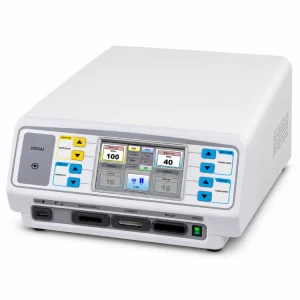
The electrosurgical unit range includes models for different operating needs. Compare the ESU-2000AI (LCD) and ESU-2000A (LED) against the department’s procedure list.
Plan for Consumables, Service, and Total Cost
Confirm the Standard Package
The purchase price is only part of the cost. Pencils, dispersive pads, pad cables, bipolar forceps, and other accessories may need regular replacement. Their availability, compatibility, and unit cost affect the budget over time. Request a model-specific packing list and separate standard items from optional accessories.
Before ordering, confirm quantities, disposable or reusable status, included forceps and cables, and compatibility with the generator. A package may still leave out items needed for routine procedures.
Review Service and Maintenance
Cooling and maintenance design matter too. The ESU-2000AI and ESU-2000A are described with convection cooling without a fan. Ask about routine inspection, electrical safety testing, spare parts, repairs, warranty, operator training, installation, and service response times. ARI Medical outlines its company background and service support online; confirm the scope for the destination market and order.
Conclusion
Choose a unit that fits the department’s procedures, instruments, safety needs, and service plan. Compare each mode at its stated load, confirm the model configuration, and check TUR and endoscopic compatibility before purchase. When the procedure list and required accessories are ready, contact ARI Medical for model guidance and a quotation.
FAQ
Q1: What Is the Difference Between Monopolar and Bipolar Electrosurgery?
Monopolar current travels from the active electrode through the patient’s tissue and returns through a dispersive electrode. Bipolar current passes through tissue held between the forceps jaws and returns through the second jaw. Bipolar use does not require a separate return pad.
Q2: How Many Modes Does a General Surgery Department Need?
There is no fixed mode count for every department. Start with the procedures performed, then check the required cutting, blend, monopolar coagulation, and bipolar functions. Extra modes matter only when they support the team’s techniques and instruments.
Q3: Is Return Electrode Monitoring Worth Considering?
REM monitors return-electrode contact and may alert the team or affect output if contact becomes inadequate, depending on the system design. It can reduce risk, but correct pad selection, placement, and skin preparation are still required.
Q4: Can One Electrosurgical Unit Serve Laparoscopy and Open Surgery?
It may, if the generator has the required laparoscopic and endoscopic connections, suitable output control, compatible electrodes, and the hand or foot controls needed. Confirm the exact configuration with the surgical team.
Q5: What Information Should a Buyer Send Before Requesting a Quotation?
Share the procedures by specialty, expected case volume, required monopolar and bipolar functions, TUR or endoscopic applications, power supply, and accessories already in use. Include the destination country and required compliance documents so the supplier can prepare a relevant quotation.